Governance
Representative Vs Presidential
Representative democracy has advantages over Presidential. Leader elects can be more easily removed from office and thus reduce the chances of creating authoritarian regimes. Cabinet is appointed by other elects, who have constituencies to defend and will more likely listen to their electorate.
Councils and assemblies will have one primary chamber, while state and union legislatures will also support a secondary chamber. The second chamber will be filled with advisors and its membership will be half the size of the primary chamber. Every four years the chambers advisors will be reappointed, by an independent commission. They would scrutinise legislation and can delay legislation for three, six or nine months, except money bills.
If there is a majority in both chambers (double majority) legislation can pass at once. An equal combined majority is where PC members are worth one point, while SC members are worth two, three months. Unequal combined majority is where both member types are worth one point, six months. If there is no combined majority of any kind and only from the primary chamber, the delay is nine months. SC members can veto legislation that directly affects their chamber.
The president is selected by both chambers of parliament/congress in an equal majority. At the beginning of each state and union terms the top four supported candidates are put through an AV election, with the winner being selected president. They will have a ceremonial role and as a last resort reset the political system. Councils and regions will have mayors.
If someone has been elected, selected or appointed they can never be a member of the other two. This is to protect the separate and unique functions of those political branches. Community leaders will be elected locally and will deal with constituency case work.
Levels of Government
There will be four levels of government, council, region, state, and union. There are no limits to the number of councils and regions being created. Each level will have its own election year, meaning four year fixed terms. Voting age and full adulthood will be sixteen.
Level
Legislature
Elects
Leader Elect
Local Authority
Council
Councillor
First Councillor
Region
Assembly
Assembly Member
Head Assembly Member
State
Parliament
Minister of Parliament
Prime Minister
Union
Congress
Representative
High Representative
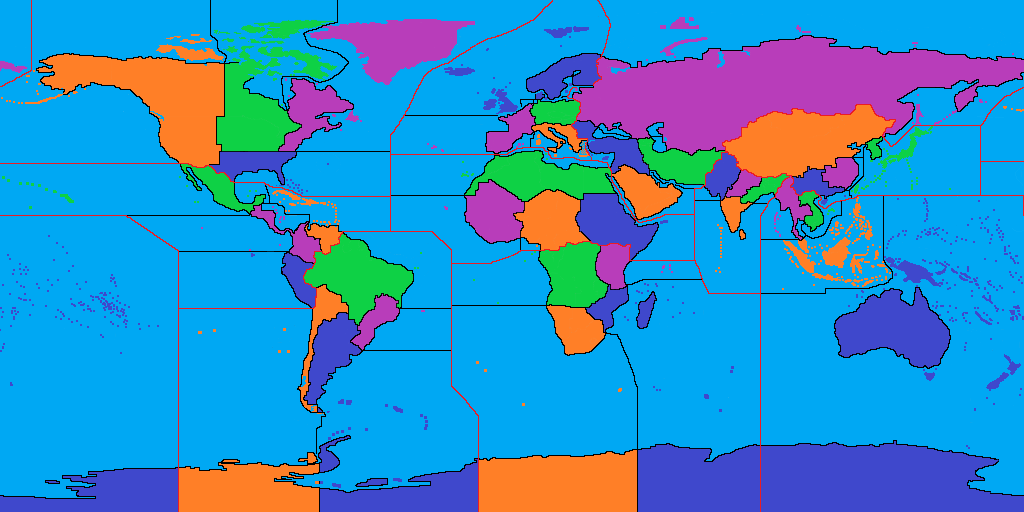
The twelve unions will be North America, Central America, South America, Euro-Africa, Euro Asia, West Asia, West Africa, South Africa, East Africa, Middle Asia, North Asia and South Asia. There will also be four Sphere Associations, American, Mediterranean, African, Asian.
Each state and union would send one ambassador to their respective association and the world assembly. Unions can veto if most of their ambassadors vote against.
 |
Union Configuration
All territories have an effective social range, in which peoples are willing to work together for collective prosperity and mutual security. Within each union four large states will reside, with the benefits being economies of scale and having the military capability to defend yourself.
Each state would be given the same amount of representation regardless of population. If over 50pc of actual state elects vote against a piece of legislation, then an actual total legislature super majority must be created, which is greater than the state s vetoing percentage.
Alternative vote (AV) elections will take place when selecting legislature or party leaders, with the top four supported candidates being put forward. Each party elects their amount of committee members and heads of committees by their percentage of seats. Elects will be given additional pay when in government or committee, which is a separate payment on top of their elects pay, meaning no severance.
Party List Single Member Districts with AV Selection
Party List Single Member Districts will use a large constituency to contain multiple single member districts, with the maximum being ten. The electorate can only select one party and AV those candidate choices.
If any candidate square is left blank, candidates higher up the list will receive the earliest possible number. This means the top candidate would receive a 1, while the bottom candidate receives a 10. You can give one candidate a 10 and leave the other candidate squares blank.
This process is the same when party members prioritise their selected candidates. To be a selected candidate the top supported party members are put on the party list. Party members can only support one potential candidate. Candidates are initially ranked by how many party votes they won.
Parties will rank districts by how many votes they won and put potential wining districts on a combined ranked list. A party wins that district by having the most votes but are limited by their winning candidates. The Hare Quota will be used for winning elects, which is total votes divided by seats, with Largest Remainder of votes being used to win remaining seats.
A four-party system is needed because core support for socialism and conservatism is divided between moderate and traditional members. These two factions need their own parties, as having a civil war while in government or opposition costs the electorate. To help solve this these two parties can form a coalition, meaning their votes are transferred if not winning in the first or second rounds.
First Past the Post and Alternative Vote
First Past the Post (FPP) is a simple solid system. The electorate cross one candidate and the one with the most votes wins. This encourages a two-party system, one socialist and the other conservative, effectively limiting voter choice.
This also increases the chances of safe seats where one party can more easily win their constituency, especially with gerrymandering. Gerrymandering in where the constituency is formed in such an unnatural way that it doesnt correspond to the local voters fixed community. This can be avoided with an independent boundary commission.
The alternative Vote (AV) is where the electorate preference their candidate choices, with the least supported being eliminated. This gives voters more of a choice when selecting candidates and the winner must achieve an actual majority. Some may feel its unfair for some votes to be counted more often than others.
D Hondt Method and Mixed Members Proportional
The D Hondt Method (DHM) is a formula that divides the partys vote share every time they win a seat. The calculation is original party votes / (seats won +1 = ) = remaining votes. So if a party had 100,000 votes and won 2 seat its 100,000 / 2+1=3 =33,333 votes.
Mixed Members Proportional (MMP) is where the FPP/AV and DHM elects are equal in number. If DHM elects are less in number than FPP/AV its called Additional Members. Before the first round of DHM elections, the FPP/AV seats already won divide the partys DHM votes first. The downside is FPP/AV elects will have to represent a constituency twice the size, you double the number of elects/cost or have less DHM elects reducing proportionality.
Single Transferable Vote
Single Transferable Vote (STV) is where the electorate can preference candidates across party lines. Your first preference might be candidate One of Party A, while your second preference is candidate Two of Party B. Additional votes above the winning threshold are passed on, to the voters next preference as a percentage.
STV more commonly uses the Droop Quota threshold, which is total votes divided by seats plus one, plus one vote. In a two seat constituency of 100,000 votes its 2 + 1 = 3 + 1 vote or 33,333 votes + 1 vote. This is the lowest possible threshold to win a seat.
If a party fields too many candidates, they could lose their vote share later. If the electorate spread their first preferences on multiple candidates within the same party and they dont win, but their second plus preferences are for other parties and their candidates.
Parties may field fewer candidates to seats available to increase the concentration of 1st preferences and this is why constituencies are normally ranged between 3-5, with the droop quota being is used, as the lower threshold favours larger parties.